What Makes a Horror Villain Scary Isn't What You Think
What makes a horror villain scary is rarely the gore. It's uncertainty: what you can't see, can't predict, and can't explain. Blood and prosthetics get the attention, and practical effects in horror built some of the genre's most memorable monsters by hand. But the villains that follow you home work on your imagination first. They hold back. They hint instead of show. And they leave the biggest questions unanswered.
This guide breaks down the five mechanics behind effective horror antagonists: restraint, implication, the unknown, an imbalanced mind, and clear rules. Each one comes with film examples and verdicts from the HorroRated archive, plus the psychology research on why uncertainty scares people more than spectacle.
On this page
Got a question or a horror pick for us?
Contact HorroRatedKey Takeaways
- Horror villains are scariest when they create uncertainty, not when they create the most gore. Gore mostly triggers disgust, while fear depends on anticipating a threat.
- Restraint makes villains scarier. The shark in Jaws (1975) is on screen for about four minutes total, and its first full appearance comes roughly 81 minutes in.
- Implication lets viewers build the villain in their own heads, which is why blank masks and off-screen threats often outlast detailed monster reveals.
- Psychology research links creepiness to ambiguity. A 2016 survey of 1,341 people found that feeling "creeped out" is a response to uncertainty about whether a threat is present.
- Over-explaining a villain usually weakens it. In HorroRated's archive, the Halloween sequels that built backstory around Michael Myers scored 1 or 2 out of 5, while the original scored 5.
Why Isn't Gore What Makes a Horror Villain Scary?
Gore produces disgust, and disgust isn't fear. Fear is about anticipation: the sense that something bad is coming and you can't stop it. A villain can be extremely violent and still not scary if you always know what it will do next.
Psychologists treat disgust and fear as separate emotions. Disgust is a recoil from something already in front of you. Fear is a warning about something that might happen. That difference matters for villains. A kill scene can make you look away. But the minutes before the kill, when you don't know where the threat is, are what make you hold your breath.
| What / When / How | Disgust (gore-driven) | Dread (uncertainty-driven) |
|---|---|---|
| What triggers it | Seeing damage already done | Sensing a threat you can't locate |
| When it peaks | During and after the kill | Before anything happens |
| What it feels like | Recoil, nausea, looking away | Tension, alertness, holding still |
| How long it lasts | Fades when the scene ends | Can linger long after the credits |
What About Villains Built Around Gore?
Some villains lean hard into gore and still work. Art the Clown is the obvious case. HorroRated gives Terrifier (2018) a 5 out of 5, and its effects work is a big part of that reputation. But look at what actually unnerves people about Art the Clown's silent menace. He never speaks. He communicates through mime, grins, and long pauses. You can't read his intent until it's too late. The gore is the payoff. The silence is the setup.
So gore isn't the enemy of a scary villain. It just can't do the job alone. When gore replaces tension instead of paying it off, the villain turns into an effects showcase.
The Five Mechanics Behind Effective Horror Antagonists
Most memorable horror villains rely on some mix of five mechanics. Each one works by withholding something from the audience, whether that's screen time, visual detail, an explanation, a readable mind, or a sense of safety.
| Mechanic | How It Scares You | Archive Example | What Breaks It |
|---|---|---|---|
| Restraint | Builds anticipation | Jaws (1975), 5/5 | Showing the villain too early or too often |
| Implication | Puts your imagination to work | Halloween (1978), 5/5 | Full reveals and lingering close-ups |
| The unknown | Keeps uncertainty active | The Thing (1982), 4/5 | Origin stories and mythology |
| Imbalanced mind | Makes the villain unreadable | Psycho (1960), 5/5 | Jokes, quips, or easy sympathy |
| Clear rules | Keeps you on alert | A Quiet Place (2018), 5/5 | Breaking the rules for a cheap scare |
The sections below break down each mechanic, with examples of it working and failing.
Restraint: Why Less Screen Time Makes a Villain Scarier
Restraint means rationing the villain's screen time so the audience spends most of the film waiting for it. Waiting is where fear builds. Every scene without the villain becomes a scene where it might appear.
How a Broken Shark Made Jaws Scarier
The most famous example of restraint happened by accident. The mechanical shark built for Jaws kept failing in the salt water off Martha's Vineyard. Steven Spielberg couldn't count on it, so he shot around it with point-of-view shots, floating yellow barrels, and John Williams's two-note theme.
The result is Spielberg's mostly unseen shark, which is on screen for about four minutes in total. Its first full appearance comes roughly 81 minutes into the film. HorroRated rates Jaws a 5 out of 5, Legendary. That long wait is a big reason why.
Why Do Villains Get Less Scary in the Third Act?
Horror fans say it all the time: movies get less scary once the monster shows up. That's restraint running out. Once the villain is fully visible, the audience can size it up. It has a shape, a speed, and limits.
The question shifts from "what is it?" to "can they beat it?" That's a different feeling, closer to action than dread. The best horror films delay that shift as long as they can. Some never make it at all.
Implication: Letting the Audience Build the Monster
Implication is showing just enough for the audience to fill in the rest. Your imagination is custom-built to scare you. Any detail a film leaves out gets replaced with your own worst guess.
John Carpenter's original 1978 Halloween is the model. Michael Myers is credited as "The Shape," not by name. His face is a store-bought mask spray-painted white. Carpenter keeps him at the edges of the frame, often in the background while characters talk up front. You notice him before they do. That gap between what you see and what they see does more work than any kill in the film.
Why Blank Masks and Hidden Faces Work
Faces are how people read intent. We check expressions constantly to decide whether someone is safe. A blank mask takes that information away. You can't tell if the villain is angry, amused, or feeling nothing at all.
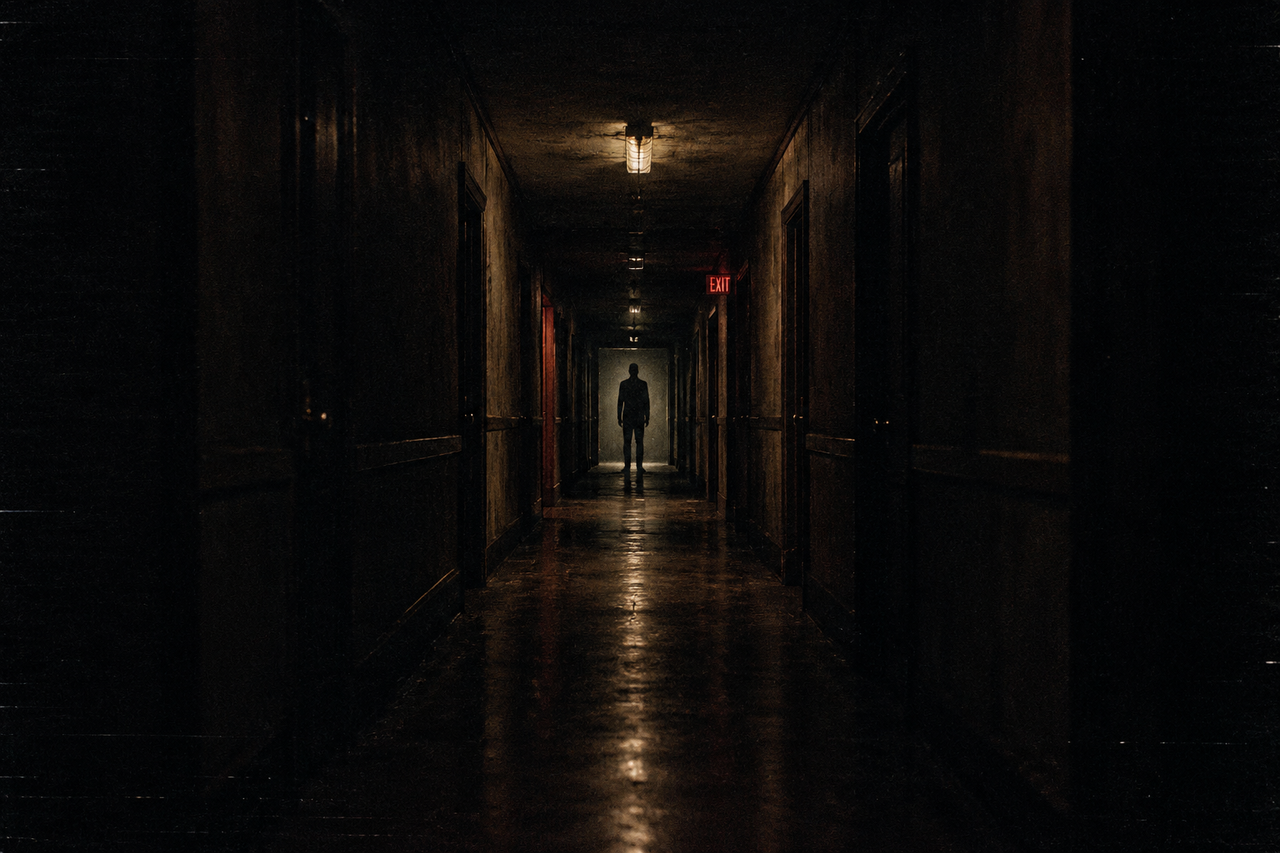
The same logic explains why a figure standing still at the end of a hallway is scarier than one sprinting at the camera. Stillness gives you nothing to read.
Can a Film Show Too Little?
Yes. The Blair Witch Project never shows its witch, and it changed found-footage horror for good. It also splits viewers more than most classics, and HorroRated rates it a 3 out of 5. A villain built entirely from absence asks a lot of the audience. Some people fill the gap with fear. Others fill it with boredom. Implication works best with a few specific, well-chosen details for your imagination to grab.
The Unknown: Why the Best Horror Villains Stay Unexplained
Fear of the unknown may be the most basic fear people have. Villains that stay unexplained keep that fear running. Villains that get fully explained become problems to solve. Cosmic horror pushes that idea the furthest, which is why "can the threat be understood?" is one of the two questions that settle cosmic horror vs Lovecraftian horror.
What Does Psychology Say About Fear of the Unknown?
Research backs up what horror fans already feel. In a 2016 review in the Journal of Anxiety Disorders, psychologist R. Nicholas Carleton of the University of Regina argued that fear of the unknown may be the most fundamental fear underlying human anxiety.
A separate 2016 study by Francis McAndrew and Sara Koehnke of Knox College surveyed 1,341 people about what makes someone creepy. Their conclusion: feeling creeped out is a response to ambiguity, specifically not knowing whether a threat is present. Unpredictable behavior was a strong signal. The authors noted that a mugger isn't creepy, because the threat is obvious. A villain whose goals you can't read keeps your threat detection switched on.
The Thing's shapeshifting paranoia fits this perfectly. John Carpenter's 1982 film never lets anyone, audience included, know for sure who's still human. The creature isn't scary because of how it looks, though Rob Bottin's effects are unforgettable. It's scary because it could be anyone in the room.
Why Backstory Can Shrink a Villain
Origin stories turn mysteries into case files. Once a villain has a clear cause, motive, and history, the audience can file it away. The Halloween franchise timeline shows the pattern in HorroRated's own verdicts:
- Halloween (1978): Michael has no stated motive. 5 out of 5, Legendary.
- Halloween II (1981): Adds a family connection behind the killings. 2 out of 5.
- Halloween 5 (1989) and Halloween: The Curse of Michael Myers (1995): Build a cult mythology to explain him. 1 out of 5 each.
- Halloween (2018): Drops those sequels and the family link, and returns Michael to an unexplained threat. 4 out of 5.
Backstory isn't the only reason those sequels scored lower. Scripts, budgets, and production trouble all play a part. But the pattern is hard to ignore. The more the films explained Michael, the less he felt like the thing Dr. Loomis warned everyone about.
An Imbalanced Mind: Why Some Villains Feel Wrong
Some villains scare us because their minds don't add up. They think clearly but feel nothing, or feel intensely with no logic behind it. That mismatch makes them impossible to predict or reason with.
A 2023 paper in Personality and Social Psychology Bulletin tested this directly. Across four studies, researchers Ivan Hernandez, Ryan Ritter, and Jesse Preston looked at how people judge monster minds. The imbalance between a monster's capacity for thinking and its capacity for feeling predicted scariness better than simply adding the two together. Their examples included Hannibal Lecter and the Terminator: very smart, almost no emotion.
Norman Bates is a quieter version of the same idea. In Psycho (1960), he's polite, shy, and a little awkward. Nothing about him reads as dangerous at first, and that's exactly what makes every scene with him tense once you sense something is off. HorroRated rates Psycho a 5 out of 5. For more villains like this, HorroRated's psychological horror shelf collects films built on minds you can't trust.
Why Slightly-Off Behavior Feels Threatening
The creepiness research points the same way. Behavior that's a little wrong, like an odd smile or a stare that lingers, signals danger without saying what kind. The Invisible Man (2020) takes this to the extreme. Its villain is literally unseen, and the film makes empty corners of a room feel hostile. HorroRated rates it a 5 out of 5.
Horror Villain Design: How the Look Supports the Fear
Good horror villain design serves the mechanics above instead of replacing them. A strong design gives the audience a clear silhouette and a few specific details, then gets out of the way. The goal is a look that's easy to recognize and hard to fully read.
- A clear silhouette. Michael's coveralls, Freddy's hat, the Xenomorph's long, curved head. You can spot them in shadow, which lets filmmakers keep them there.
- A hidden or unreadable face. Masks, stillness, or no face at all remove the cues people use to judge intent.
- Something almost human. Figures that are close to human but slightly wrong land in what roboticist Masahiro Mori called the uncanny valley in 1970. Wrong proportions, wrong movement, or a smile that doesn't fit.
- One signature detail. A glove, a sound, a weapon, or a phrase. One repeated detail becomes a warning sign the audience learns to dread.
Alien (1979) shows design and restraint working together. H.R. Giger's creature is one of the most striking designs in film, and Ridley Scott barely lets you see it. It's usually in shadow, in pieces, or moving too fast to study. The design sticks with you because you never get a comfortable look at it. HorroRated rates Alien a 5 out of 5.
Why Clear Rules Make a Horror Villain Scarier
It sounds backwards, but rules make villains scarier, not weaker. A rule tells the audience exactly what triggers the threat. From then on, every character who breaks it, or almost breaks it, creates a moment of dread.
A Quiet Place's sound-hunting creatures are the clearest modern example. The film teaches one rule early: make noise and you die. After that, a dropped object or a creaking stair becomes unbearable. The creatures barely need to appear. HorroRated rates the film a 5 out of 5.
Candyman (1992) works the same way. Say his name five times in a mirror and he comes. The rule is simple, so the audience knows exactly where the danger is. Freddy Krueger's rule, that he can only get you while you sleep, turns something everyone has to do into a trap.
What Happens When a Villain Breaks Its Own Rules?
Trouble starts when a film bends its own rules for a bigger scare. If the villain can suddenly appear anywhere, tension resets to zero. The audience stops watching the rule and starts bracing for the next jump scare. Rules only work if the film respects them.
Common Mistakes That Make Horror Villains Less Scary
Most villains don't lose their power all at once. It drains away through a handful of repeatable choices, usually in sequels, remakes, or third acts that try to give the audience more.
- Explaining too much. Origin stories and mythology trade mystery for logic, as the Halloween verdicts above show.
- Overexposure. A villain in every scene stops being a threat and starts being a character.
- Turning menace into jokes. Freddy Krueger's franchise arc tracks this in HorroRated's verdicts. The 1984 original earns a 5 out of 5. By The Dream Child (1989) and Freddy's Dead (1991), Freddy is trading in punchlines, and both films score 2 out of 5.
- Letting gore replace tension. Kills without buildup feel like effects demos, not threats.
- Breaking the villain's own rules. Inconsistent powers make every scene feel arbitrary.
- Making the villain predictable. Once the audience can call every move, dread turns into routine.
None of these are hard rules. Plenty of fans love wisecracking Freddy, and a campy villain can be a blast. But fun and scary are different goals, and a villain built for one rarely delivers the other.
How to Spot a Well-Built Horror Villain on Your Next Watch
You can test any horror villain against these mechanics while you watch. These five checks work for classics and new releases alike.
- Clock how long it takes the villain to fully appear. Longer waits usually mean more dread.
- Notice what the film won't show you, like a face, an origin, or a clear motive.
- Ask whether you can predict the villain's next move. If you can't, the film is doing its job.
- Find the rule. Once you know what triggers the threat, watch how the film uses it.
- Pay attention to how you feel after the credits. Dread tends to stick around longer than shock.
One more thing to watch: who the villain is up against. A threat feels bigger when the final girl who has to face it is sharp and paying attention, because the film has to work harder to scare someone who's already looking.
Want a place to practice? Every entry in the HorroRated movie archive has a verdict on a 0 to 5 scale and a written reason behind it, so you can see which villains earned their scares before you press play.
Frequently Asked Questions About Scary Horror Villains
What makes a horror villain scary?
A horror villain is scary when it creates uncertainty the audience can't resolve. Restraint, implication, an unexplained origin, an unreadable mind, and clear rules all keep viewers guessing about when and how the threat will strike. Gore can add shock, but fear comes mostly from anticipation.
What makes a good horror villain?
A good horror villain has a simple, recognizable presence and a threat the audience can't fully predict. It needs a strong silhouette or signature detail, consistent rules, and enough mystery to keep the fear alive. The best ones also connect to a real fear, like being watched, being alone, or not being believed.
Why are unseen monsters scarier than ones you can see?
Unseen monsters force viewers to imagine the threat, and imagination usually produces something scarier than any design on screen. Once a monster is fully shown, the audience can judge its size, speed, and limits, which makes it feel beatable. Keeping it hidden keeps that judgment on hold.
Does gore make a horror villain scarier?
Gore usually makes a horror villain more shocking, not more frightening. Gore triggers disgust, a reaction to something already seen, while fear is a reaction to something that might happen next. Gore works best as the payoff to tension a film has already built.
Why do horror villains get less scary in sequels?
Horror sequels tend to explain villains, show them more often, and make them familiar, and each of those choices removes uncertainty. Origin stories, cult mythologies, and running jokes turn an unknowable threat into a known character. Franchises that reset a villain back to mystery often win back some of the original fear.
Why do masks make horror villains scarier?
Masks hide the facial expressions people rely on to judge whether someone is dangerous. Without a readable face, the audience can't tell what a masked villain feels or plans to do next. Psychology research links that kind of ambiguity directly to the feeling of being creeped out.
Who is the scariest horror villain of all time?
There's no single scariest horror villain, because different villains scare people for different reasons. The shark in Jaws (1975) and Michael Myers in Halloween (1978) are among the most cited, and both earn HorroRated's top verdict of 5 out of 5, Legendary. Which villain scares you most depends on which fear hits closest: being hunted, being watched, or not knowing what's real.