
Cosmic Horror vs Lovecraftian Horror: What's the Difference?
Cosmic horror and Lovecraftian horror overlap so much that most fans use the terms interchangeably, but they aren't the same thing. Cosmic horror is a feeling: dread of a universe so vast and indifferent that people barely register in it. Lovecraftian horror is a family tree: stories drawn from H.P. Lovecraft's fiction or built from his recognizable toolkit. HorroRated's curated cosmic horror films and its Lovecraftian shelf share seven titles, which shows how tangled the two labels get. Here's how to tell them apart, and why it matters when you're picking tonight's movie.
On this page
Got a question or a horror pick for us?
Contact HorroRatedKey Takeaways
- Cosmic horror is the broad label for dread of a vast, indifferent universe, where people barely matter and the threat can rarely be understood or beaten.
- Lovecraftian horror is the narrower label for stories drawn from H.P. Lovecraft's fiction or built from his toolkit of forbidden books, ancient entities and cults.
- Most Lovecraftian horror is cosmic, but not all of it: Re-Animator (1985) adapts a Lovecraft story yet keeps its threat human-sized, while Nope (2022) is cosmic without owing Lovecraft anything.
- The fastest test is two questions: where did the story come from, and can the threat be understood?
- HorroRated keeps two separate shelves, Cosmic Horror with 21 entries and Lovecraftian with 18, and seven films sit on both.
Cosmic Horror vs Lovecraftian Horror at a Glance
Cosmic horror describes a kind of fear; Lovecraftian horror describes where a story comes from. Cosmic horror is about scale and indifference: a reality too big to grasp and a threat that doesn't care whether you live. Lovecraftian horror is about lineage: Lovecraft's own stories, his style and his creatures, and the many books and films that borrow them.
| Cosmic horror | Lovecraftian horror | |
|---|---|---|
| What the label tracks | A feeling and a worldview: people are tiny in an indifferent universe | A lineage: H.P. Lovecraft's stories, style and creatures, and work that borrows them |
| Where it comes from | Roots older than Lovecraft's tales (Robert W. Chambers, Algernon Blackwood) | Named after H.P. Lovecraft (1890 to 1937) |
| Typical threat | Something vast, unknowable and indifferent that can rarely be beaten | Ancient entities, cults, forbidden books, cursed bloodlines |
| Typical setting | Anywhere: deep space, a ranch, a suburb | Old New England towns, universities, isolated old places |
| Example on HorroRated | Nope (2022), on the Cosmic Horror shelf only | Re-Animator (1985), on the Lovecraftian shelf only |
Fans swap the two labels all the time, and in casual conversation that's fine. The difference starts to matter when you're choosing what to watch, because a Lovecraft adaptation can be a gory comedy, while some of the most cosmic films ever made never mention him.
What Is Cosmic Horror?
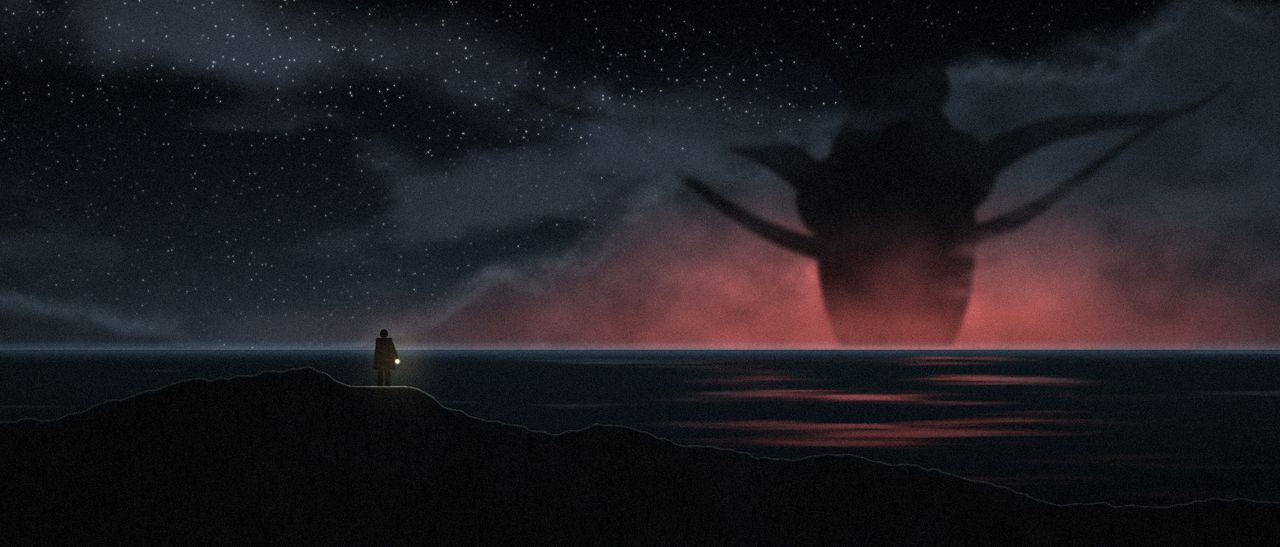
Cosmic horror is horror where the fear comes from scale: a universe too large to understand, forces that don't notice people, and usually no clean victory at the end. The monster isn't hunting you. It barely knows you exist, and that's the problem.
Lovecraft gave the idea its best-known description. His essay Supernatural Horror in Literature, written between 1925 and 1927, opens with the line most fans can quote: "The oldest and strongest emotion of mankind is fear, and the oldest and strongest kind of fear is fear of the unknown." In a July 1927 letter to Farnsworth Wright, he said his stories rest on the premise that "common human laws and interests and emotions have no validity or significance in the vast cosmos-at-large" (source).
On screen, cosmic horror shows up as glimpses instead of full reveals, explanations that make things worse, and characters who learn more than a person can carry. It's the same reason what makes a horror villain scary is so often what you don't see: the unknown does more work than any creature design.
Did Cosmic Horror Exist Before Lovecraft?
Yes, in spirit. Robert W. Chambers's story collection The King in Yellow (1895) is often read as an ancestor of Lovecraft's cosmic fear (source), and Algernon Blackwood's "The Willows" (first published in 1907) is the tale Lovecraft himself named "foremost of all" among Blackwood's stories. Lovecraft sharpened the idea and gave it its most famous name, but who started cosmic horror is a debate, not a settled fact.
What Makes a Horror Story Lovecraftian?
A story is Lovecraftian when it draws on H.P. Lovecraft's fiction or his recognizable toolkit: forbidden books, scholars who dig too deep, ancient entities and the cults that serve them, decaying New England towns, and madness as the price of knowing. Lovecraft lived from 1890 to 1937 (source), and nearly a century later his name is still shorthand for that whole kit.
The label gets used two ways. The strict sense covers stories adapted from Lovecraft or set in his world. The loose sense covers anything that borrows his themes, even with no Lovecraft source at all. HorroRated's Lovecraftian shelf uses the looser sense, which is why some films with no Lovecraft credit sit there.
The clearest strict example is Stuart Gordon's Re-Animator (1985), credited as based on Lovecraft's "Herbert West" tale, serialized in 1922 (source). It's pure Lovecraft on paper and pure mad-scientist mayhem on screen, which makes it the easiest place to see where the two labels part ways.
Is Lovecraftian the Same as the Cthulhu Mythos?
Not quite. The Cthulhu Mythos is the shared set of names, places and creatures: Cthulhu, Arkham, the Necronomicon. Lovecraftian describes the themes and the feel. A Mythos story is always Lovecraftian, but a Lovecraftian story doesn't need to mention Cthulhu once. The term "Cthulhu Mythos" is usually credited to August Derleth, one of the writers in Lovecraft's circle (source), though a 1931 letter in which Lovecraft calls "Cthulhu & his myth-cycle" his own invention keeps the credit debated (source).
Why Do Some Fans Say "Cosmic Horror" Instead of "Lovecraftian"?
Partly precision, partly Lovecraft himself. His racist views are well documented, and many writers and fans prefer the neutral label for work that shares his ideas but not his worldview. One public marker came in 2015, when the World Fantasy Award announced it would stop using Lovecraft's likeness as its trophy (source).
Where Cosmic and Lovecraftian Horror Overlap, and Where They Split
The two labels answer different questions, so a film can be both, one or neither. Lovecraftian asks where the story comes from. Cosmic asks what kind of fear it leaves you with.
| Where it sits | What it looks like | Example from the archive | HorroRated verdict |
|---|---|---|---|
| Lovecraftian and cosmic | A Lovecraft source plus a reality too big to grasp | From Beyond (1986) | Recommended |
| Lovecraftian, not cosmic | A Lovecraft source, but a human-sized threat | Re-Animator (1985) | Legendary |
| Cosmic, not Lovecraftian | No Lovecraft source; vast, indifferent dread | Nope (2022) | Legendary |
| Lovecraftian in spirit | An original story using the toolkit: isolation, paranoia, the unknowable | The Thing (1982) | Highly Recommended |
Lovecraftian, not cosmic. Re-Animator has a Lovecraft source, but its threat is a scientist and his serum: human-sized, a little ridiculous and darkly funny. Nobody walks out of it feeling small in the universe.
Cosmic, not Lovecraftian. Jordan Peele's Nope (2022) owes Lovecraft nothing, yet something hiding in the clouds gives it pure cosmic scale: a threat overhead that's vast, barely understood and impossible to reason with.
Lovecraftian in spirit. John Carpenter's The Thing (1982) isn't based on Lovecraft, but an Antarctic shape-shifter brings the toolkit anyway: isolation, paranoia and something no one can fully understand. That's why it sits on both of HorroRated's shelves.
How to Tell Which One You're Watching
Five quick checks sort almost any film:
- Check the source. If it's adapted from or set in Lovecraft's stories, it's Lovecraftian in the strict sense, and the credits often carry his name.
- Look for the toolkit. A forbidden book, a scholar or investigator, an old cult or a decaying town points toward Lovecraftian, even without a credit.
- Ask whether the threat can be understood. If the film explains its monster fully, it's leaving cosmic territory.
- Ask whether it can be beaten. Cosmic horror rarely offers a clean win; surviving often just means getting away for now.
- Watch what knowledge does to people. In both traditions, learning the truth tends to cost characters their safety or their sanity.
If checks 1 and 2 say yes, you're watching something Lovecraftian. If checks 3 to 5 say yes, it's cosmic. If they all do, it belongs on both shelves.
Which HorroRated Films Fit Each Label?
HorroRated keeps two separate shelves, Curated Cosmic Horror with 21 entries and Curated Lovecraftian Horror with 18, and seven titles sit on both. Here's where the best-known ones land, with each film's HorroRated verdict.
On both shelves:
- From Beyond (1986), Recommended. Another Stuart Gordon adaptation of a Lovecraft story, built around a machine that wakes a hidden sense.
- Hellraiser (1987), Legendary. Clive Barker's film sits on both shelves, and the Hellraiser franchise timeline untangles the sequels that followed.
- Guillermo del Toro's Cabinet of Curiosities (2022), Legendary. A horror anthology series filed under both labels, so it works as a sampler of each.
- The Thing (1982), Highly Recommended. Lovecraftian in spirit and cosmic in scale.
- No One Will Save You (2023), Highly Recommended. A film with almost no dialogue that turns an alien premise into isolation and guilt.
Lovecraftian shelf only:
- Re-Animator (1985), Legendary. Lovecraft's story, played as gory dark comedy.
- Silent Hill (2006), Legendary. A fog-bound town with rules no visitor understands.
Cosmic shelf only:
- Nope (2022), Legendary. Big-sky dread with no Lovecraft source.
- Alien (1979), Legendary. The borderline case covered below.
Common Mix-Ups: Eldritch, Sci-Fi and Tentacles
Three things get confused with cosmic and Lovecraftian horror more than anything else. Here's how to sort each one.
Is Eldritch Horror a Separate Genre?
No. "Eldritch" is an old adjective meaning "suggesting the operation of supernatural influences" (source). Fans often use "eldritch horror" as a third name for the same shelf, but the word describes a creature or a mood, not a subgenre.
Is Cosmic Horror Just Sci-Fi Horror?
They overlap, but they aren't the same. Sci-fi horror can be cosmic when it reaches for deep space and alien intelligence, but most sci-fi monsters have a biology and a weak spot, which is the opposite of cosmic dread. Run the "can it be understood or beaten?" test from above. Alien (1979) is the classic borderline case, which is why HorroRated files it on both the curated sci-fi horror shelf and the Cosmic Horror shelf.
Is Every Tentacle Monster Lovecraftian?
No. Tentacles are shorthand, not a test. A creature that looks borrowed from Cthulhu doesn't turn a straightforward creature feature into Lovecraftian horror; check the source and the kind of dread instead.
Related Resources
- The scary vs horror label debate: another pair of labels that overlap more than people think
- Guillermo del Toro's horror anthology: a series on both shelves
- Body horror with a cosmic edge: the shelf where From Beyond, Re-Animator and The Thing also sit
Where to Start With Cosmic and Lovecraftian Horror Tonight
Still not sure which mood you're in? Open the Movie Night Generator, set the collection to Cosmic Horror or Lovecraftian, and pick tonight's horror movie from the archive. Either way, you'll end up somewhere very big, very old and completely uninterested in you.
Frequently Asked Questions About Cosmic Horror vs Lovecraftian Horror
Is cosmic horror the same as Lovecraftian horror?
No, but they overlap heavily. Cosmic horror is the broad feeling of being tiny in an indifferent universe. Lovecraftian horror is the narrower label for stories drawn from H.P. Lovecraft's fiction or his recognizable themes. Most Lovecraftian stories are cosmic, but plenty of cosmic horror owes Lovecraft nothing.
Did H.P. Lovecraft invent cosmic horror?
Not on his own. Robert W. Chambers (The King in Yellow, 1895) and Algernon Blackwood ("The Willows," 1907) wrote cosmic dread before Lovecraft's best-known stories. Lovecraft gave the idea its sharpest form and its most famous name, so who started it is still debated.
Can a movie be Lovecraftian without being based on a Lovecraft story?
Yes, in the loose, theme-based sense most fans use. A film that leans on forbidden knowledge, ancient entities and isolation can feel Lovecraftian without a Lovecraft credit. HorroRated's Lovecraftian shelf includes The Thing (1982) for exactly that reason.
Does Event Horizon count as Lovecraftian horror?
It's debated. Some fans argue that Lovecraftian stories stay grounded on Earth, which would make Event Horizon (1997) cosmic horror at most, while others count any story where seeing too much breaks the mind. Event Horizon isn't in HorroRated's archive, so it has no HorroRated verdict.
What's the difference between eldritch horror and cosmic horror?
"Eldritch" is a descriptive word for something strange, unnatural and frightening, while cosmic horror is a subgenre. An eldritch creature can appear in a cosmic horror story, but the word on its own doesn't name a genre.
Is Alien cosmic horror or sci-fi horror?
Mostly sci-fi horror with a cosmic edge. Its creature can be fought, which pulls it toward sci-fi, but the sense of something ancient and unexplained out in space gives it cosmic scale. HorroRated files Alien (1979) on both its Sci-Fi Horror and Cosmic Horror shelves.
Which cosmic or Lovecraftian movie should I watch first?
Pick by mood. Re-Animator (1985) is Lovecraft with dark laughs, Nope (2022) brings big-sky cosmic dread, and From Beyond (1986) lands on both shelves at once. All three are in HorroRated's archive, each with its verdict on its entry page.